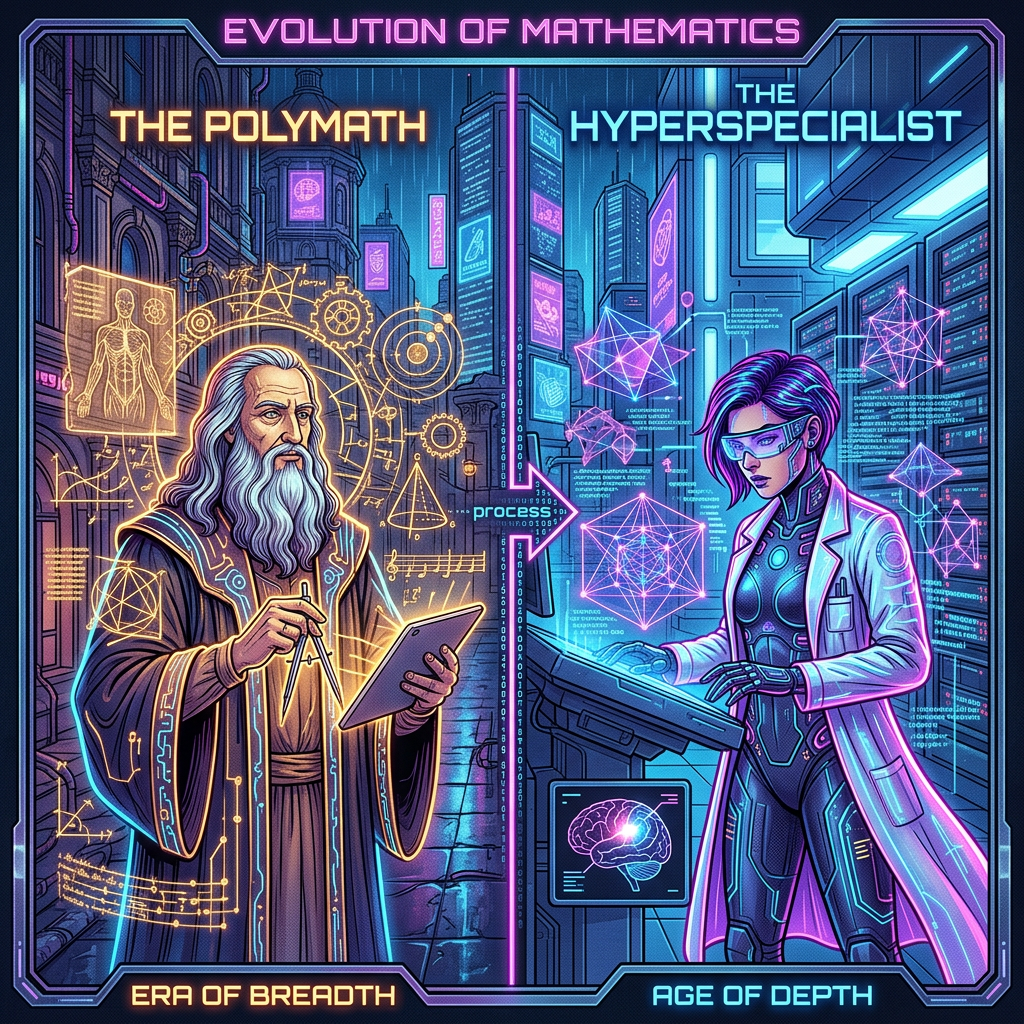
Picture a packed conference hall. Hundreds of the world’s smartest people who have devoted their entire lives to mathematics. They sit through presentations on the most advanced ideas their field has to offer. Now picture the awkward truth: a significant portion of the audience cannot follow what the speaker is saying. Not because they are not paying attention. Not because they lack intelligence. But because the mathematics being discussed belongs to a corner of the discipline so narrow, so deep, so remote from their own corner, that it might as well be a foreign language.
This is not a thought experiment. It is a routine feature of modern mathematical life. And it raises a profound question: is this a crisis or is it one of the most productive things that has ever happened to human knowledge?
What Is Hyperspecialization, Exactly?
The word “specialization” in academia is familiar enough. A biologist might focus on mammals rather than plants; a historian on medieval Europe rather than ancient China. But hyperspecialization is something more extreme, more layered, and more fascinating than that.
In mathematics, the field has fractured not just into branches, but into branches of branches of branches. Consider: mathematics contains the broad field of algebra. Within algebra, there is group theory. Within group theory, there is the theory of infinite-dimensional Lie groups. Within that, there is the representation theory of reductive algebraic groups over p-adic fields. And within that sub-sub-sub-corner, a researcher might spend thirty years, publish dozens of papers, win prestigious awards, and still be understood only by perhaps two hundred people worldwide.
That is hyperspecialization: the condition in which a professional researcher’s expertise has been drilled so deep into one shaft that the surface of the broad, open landscape of mathematics in general, has become genuinely distant.
The Mathematics Subject Classification (MSC), the official taxonomy used to catalog mathematical papers, currently lists 63 top-level areas, 529 three-digit sub-areas, and more than 6,000 five-digit specialties. That is 6,000 distinct intellectual territories, each with its own language, tools, and open questions.
To grasp how extraordinary this is, consider a useful parallel: medicine. In the 19th century, most doctors were generalists. That is, the village physician who set broken bones, delivered babies, treated fevers, and diagnosed infections. Today, a hand surgeon and a neuroradiologist and a pediatric cardiologist all share the title “doctor”, but they operate in worlds so distinct that one cannot routinely perform the work of another. Nobody considers this a failure of medicine. The patient with a tumor in the wrist is far better served by a hyper-trained hand surgeon than by a well-meaning generalist. The depth of specialization is precisely what makes the treatment effective.
Mathematics works the same way. And just as specialized medicine has extended life expectancy and reduced suffering in ways the village doctor never could, hyperspecialized mathematics has produced results of astonishing power, many of which quietly underpin the technology and science that the rest of the world uses every day.
The Giants Who Knew Everything — Because They Could
To understand how radical the current situation is, it helps to look back at the titans of the past and appreciate something about them that is easy to miss: they could only do what they did because mathematics was still small enough to hold in one mind.
Leonhard Euler (1707–1783) is perhaps the most prolific mathematician in history. He made foundational contributions to analysis, number theory, graph theory, mechanics, optics, and the calculus of variations, essentially defining several of those fields from scratch. He even kept contributing after going completely blind in 1771, dictating papers at a rate that embarrassed his fully-sighted peers. The breadth is staggering, but the total body of formal mathematics in Euler’s era, while vast by contemporary standards, was a fraction of what exists today.
Carl Friedrich Gauss (1777–1855) contributed to number theory (the Disquisitiones Arithmeticae, still considered one of the greatest mathematical books ever written), invented the method of least squares, developed the normal distribution in statistics, did foundational work in differential geometry, and made major contributions to astronomy and geodesy. He is frequently called the Princeps mathematicorum, that is, the Prince of Mathematicians.
Gottfried Wilhelm Leibniz and Isaac Newton each invented calculus independently, while simultaneously doing major work in physics, philosophy, optics, and mechanics. Bernhard Riemann (1826–1866) produced his famous hypothesis about the distribution of prime numbers, invented the geometry that Einstein would later need for general relativity, and transformed complex analysis, all in a career cut short by tuberculosis at age 39.
Then came Henri Poincaré (1854–1912), widely regarded as the last person to earn the title of “The Last Universalist”. Poincaré made world-class contributions to complex analysis, topology, celestial mechanics, special relativity (independently of Einstein), and the philosophy of science. He was the last major figure who could credibly claim to have mastered essentially all of mathematics as it existed in his time. After him, the field had simply grown too large.
David Hilbert (1862–1943) was the last mathematician who could set an agenda for all of mathematics. In 1900, he presented 23 open problems that defined the research program for the entire 20th century, a feat that would be inconceivable for any single person today, because no one person understands enough of all the parts.
And then there is John von Neumann (1903–1957), widely considered the last mathematician to have actually mastered the field at a research level in nearly all its domains. Von Neumann made foundational contributions to set theory, quantum mechanics, game theory, computer architecture, and economics. And then co-created the atomic bomb on the side. When researchers today wonder who the modern equivalent of von Neumann might be, the answer is almost always: there isn’t one, and there can’t be.
How the Polymath Era Compares to Today
| Era | Representative Figure | Breadth Possible? | Why |
|---|---|---|---|
| 1600s–1700s | Leibniz, Newton, Euler | Yes — fully | Mathematics was young and small |
| 1800s | Gauss, Riemann | Largely yes | Field growing; polymaths still feasible |
| 1850–1912 | Poincaré | Just barely | Last person to span all of it |
| 1900–1930 | Hilbert | Could lead all of it | Could identify problems across all fields |
| 1903–1957 | Von Neumann | Closest to full mastery | Exceptional talent; field still manageable |
| 1960–present | Tao, Scholze | Broad within a cluster | Too vast for any full coverage |
The table tells a clear story: the era of the mathematical polymath was not a product of superior genius. It was a product of a young field that had not yet exploded.
The Big Bang of Mathematics
The 20th century was mathematics’ Big Bang. In less than one hundred years, the discipline expanded from a large but navigable territory into something so vast that the boundaries are no longer even visible from the center.
Several forces drove this explosion. First, the Bourbaki program, a French collective of mathematicians that rewrote the foundations of mathematics in the most abstract, general terms possible from the 1930s onwards. It pushed every subfield toward maximal generality. Every concept was redefined in terms of set theory and axioms. The result was breathtaking rigor and power, but also a proliferation of abstraction that created new subfields almost automatically. Second, the post-war growth of universities worldwide created an explosion of professional mathematicians: tens of thousands of researchers where there had previously been hundreds. Third, the computer age created entire new areas: computational mathematics, cryptography, algorithmic number theory, information theory, many of which had barely existed before.
The numbers tell the story plainly. Mathematical literature grows at roughly 3.6% per year, meaning it doubles every 19 years. Today, roughly 30,000 pure mathematics papers are published annually. The result: no human being, no matter how talented, can read even a tiny fraction of what is produced in mathematics each year, let alone master it.
Fields Medal laureate David Mumford, in a landmark address to the International Mathematical Union in 1998, put the challenge directly: “can we maintain our tradition of communicating between all the diverse areas within mathematics and resisting the trend to become ever more specialized?” That question has only grown more urgent in the decades since.
The Pressures That Push Researchers Into Silos
Hyperspecialization does not just happen because knowledge expands. Specific structural pressures push individual researchers toward narrowing their focus, year by year, until the horizon closes in around them.
The Depth Problem
Modern mathematics has consumed its low-hanging fruit. The problems that remain on the frontier require extraordinary preparation even to understand, often years of study before a researcher can read the relevant literature, let alone contribute to it. A PhD student today typically spends five to seven years mastering one narrow sub-field, and even then may only scratch its surface. There is simply no time budget left for breadth.
“Publish or Perish”
The academic incentive system rewards quantity of publications, impact within a defined niche, and citation counts within that niche. A researcher who spends two years learning enough differential geometry to make a connection with their work in algebraic combinatorics takes a genuine career risk: they publish less, appear less productive, and may not gain the recognition of specialists in either field.
As mathematician Gian-Carlo Rota observed, “high-caliber expository work is more exploited than rewarded by the mathematical community”. Writing papers that translate and connect ideas across subfields, arguably the most valuable service a mathematician can perform, earns almost no institutional credit. The incentives are clear: go deep, not wide.
The Ecosystem of Niches
Once a subfield has its own journals, conferences, and professional societies, communication with other areas declines sharply. Researchers submit to journals their peers review; attend conferences their colleagues attend; write in a vocabulary their community has developed. The result is a self-reinforcing isolation that Mumford described as causing researchers to “frequently rediscover related results” independently, unaware that the same idea had already appeared in a different language in a different part of mathematics.
The Abstraction Ratchet
As Mumford noted in his 1998 IMU address, the Bourbaki-era push toward abstraction created a specific mechanism of hyperspecialization: “Once versed in this procedure, mathematicians found that it could be applied to every small subspecialty, making abstractions which codified their insight but also made them inaccessible to others.” Each subfield develops its own abstract framework, which is powerful within that field but opaque to outsiders, and this dynamic feeds on itself indefinitely.
A Tale of Two Mathematicians — and Everyone Else
Before evaluating whether hyperspecialization is a problem, it is essential to draw a distinction that is often blurred in popular discussions: the difference between those who produce mathematics and those who use it.
The Professional Mathematical Researcher
A research mathematician’s job is to produce new mathematics. For example, to prove theorems that did not exist before, to discover structures that were previously hidden, to push the known frontier into the unknown. For this job, hyperspecialization is not a flaw. It is a functional necessity. The frontier is extraordinarily technical. The problems are extraordinarily hard. Getting there at all requires years of focused preparation, and staying productive at the frontier requires maintaining and deepening that specialization continuously.
When Andrew Wiles proved Fermat’s Last Theorem in 1995, solving a problem that had defeated every mathematician for 358 years, he did it by locking himself in an attic study for seven years, working almost entirely alone. His proof required mastering and combining modular forms, elliptic curves, and Galois representations at the deepest level. No generalist could have done it. The hyperspecialization was not the obstacle; it was the instrument.
The Mathematical Practitioner
The situation is entirely different for the vast majority of people who use mathematics professionally: engineers, physicists, data scientists, economists, biologists, computer scientists, financial analysts, architects. These practitioners need mathematics, often extremely sophisticated mathematics, but their job is to apply existing results, not to generate new ones.
A structural engineer using finite element methods does not need to know the cutting-edge research in partial differential equations. A machine learning researcher deploying neural networks does not need to follow the latest work in combinatorial topology. A cryptographer building secure communications systems uses results from number theory that were often proved decades earlier, by specialists whose papers they will never read.
For the practitioner, hyperspecialization is essentially irrelevant, or rather, it is invisibly beneficial. The specialist produces the result; the practitioner eventually inherits it in a textbook or a software library. The incomprehensible frontier work of one generation becomes the standard toolkit of the next.
The Key Difference, Side by Side
| Dimension | Research Mathematician | Mathematical Practitioner |
|---|---|---|
| Primary role | Produce new mathematics | Apply existing mathematics |
| Relationship to frontier | Works at the frontier | Works below the frontier |
| Effect of hyperspecialization | Necessary to function; creates communication challenges | Largely invisible; benefits from it indirectly |
| Depth needed | Extreme within one niche | Broad working knowledge across several areas |
| Example figures | Andrew Wiles, Grigori Perelman, Jean Bourgain | NASA engineers, machine learning researchers, financial quants |
| Output | Theorems, proofs, new mathematical structures | Products, models, systems, analyses |
Back to the medical analogy: a cardiac surgeon and a patient are not in the same situation regarding medical specialization. The surgeon needs extreme depth to perform a safe operation; the patient needs the surgery to work. The surgeon’s inability to discuss dermatology with a colleague at a conference is invisible and irrelevant to the patient, who is getting a far better outcome than the village doctor could have provided. The practitioner of mathematics is in the position of the patient: the hyperspecialization of researchers is not their burden; it is their inheritance.
Why This Is Actually Good News for Everyone
Step back from the conference hall where the algebraic topologist and the number theorist cannot follow each other’s talks, and look at the bigger picture. What is the product of all this incomprehensible, siloed, hyperspecialized mathematics?
An unprecedented expansion of human capability.
Because every front of mathematics advances simultaneously — because number theorists, topologists, analysts, combinatorialists, probabilists, and algebraic geometers are all pushing their respective boundaries at the same time — society inherits a continuously expanding toolkit that none of the specialists even intended to create for practical use.
Consider a few examples of what was once incomprehensible frontier research and is now foundational infrastructure:
- Encryption (which secures virtually every internet transaction on Earth) rests on properties of prime numbers proved by specialists in number theory: mathematicians who were simply curious about primes, not solving a security problem.
- MRI imaging (which saves millions of lives annually) depends on Fourier analysis and integral transforms, developed by pure analysts with no medical application in mind.
- GPS accuracy depends on Einstein’s general relativity, which required Riemannian geometry — a field developed by Bernhard Riemann decades before any practical application was conceivable.
- Error-correcting codes (which allow digital communication to work reliably) are based on algebraic coding theory, a branch of abstract algebra.
- Modern AI and neural networks depend heavily on linear algebra, optimization theory, probability, and statistics — results accumulated across decades by specialists in each of those subfields.
None of these practitioners needed to understand the original research. They needed the results to be available, proven, and reliable. Hyperspecialization is precisely the mechanism that made those results available — by allocating human cognitive effort to every corner of the field simultaneously, rather than spreading it thinly across the whole.
What Society Gains from Hyperspecialization
| Benefit to Society | Mathematical Foundation | Original Specialists |
|---|---|---|
| Internet security (HTTPS, banking) | Prime number theory, elliptic curves | Number theorists |
| Medical imaging (MRI, CT) | Fourier analysis, integral transforms | Functional analysts |
| GPS navigation | Riemannian geometry, special relativity | Differential geometers |
| Digital communication | Error-correcting codes, information theory | Algebraic combinatorialists |
| AI and machine learning | Linear algebra, optimization, statistics | Multiple specialists |
| Climate modeling | Numerical analysis, PDEs | Applied mathematicians |
| Financial risk models | Stochastic calculus, probability theory | Probabilists |
The village doctor could treat everything, but could not cure cancer, repair a heart valve, or diagnose a brain tumor. The hyper-specialized surgeon can do all three of those things (though not the same surgeon for all three). The patient is better off. So is the world.
The Real Risks: When Silos Block Breakthroughs
And yet, hyperspecialization is not without genuine costs, and they are serious enough that leading mathematicians have sounded the alarm repeatedly.
The central irony is this: the most transformative mathematical breakthroughs often come precisely from connecting two distant subfields, and hyperspecialization makes those connections harder to find, harder to execute, and less likely to be rewarded when attempted.
The history of major 20th and 21st century breakthroughs is largely a history of cross-field synthesis:
- Fermat’s Last Theorem (Wiles, 1995): Proved by connecting number theory to the then-separate world of elliptic curves and modular forms, fields that specialists had not previously thought of as deeply related.
- The Green-Tao Theorem (2004): Ben Green and Terence Tao proved that the prime numbers contain arbitrarily long arithmetic progressions by fusing ideas from analytic number theory, ergodic theory, and additive combinatorics, three fields that rarely communicated.
- The Poincaré Conjecture (Perelman, 2003): The most famous open problem in topology was finally solved not by a topologist, but by Grigori Perelman using techniques from differential geometry and the Ricci flow, a tool from a completely different area of mathematics.
- Jean Bourgain’s work on the Kakeya problem: A purely geometric question (how small an area can you sweep a needle through every angle in?) was cracked open by importing machinery from additive number theory, visible only to someone who had bothered to understand both fields.
These breakthroughs share a common feature: they were possible because someone crossed the aisle between specialized neighborhoods. Hyperspecialization threatens to make those crossings rarer, because the specialists do not speak the same language and the academic incentive system does not reward the years of effort required to learn it.
Other documented costs include:
Loss of the “big picture”: David Mumford warned that mathematics risks losing its identity as a unified intellectual enterprise if specialists stop being able to communicate across its breadth
Duplication of effort: Mathematicians in different subfields independently prove the same results, unaware of each other’s work, because they read different journals and attend different conferences.
Broken communication chains: As Fields Medal winner William Thurston wrote, “Basic concepts used every day within one subfield are often foreign to another subfield. Mathematicians give up on trying to understand the basic concepts even from neighboring subfields, unless they were clued in as graduate students.”
Narrowing of young researchers: PhD students trained ultra-narrowly may lack the mathematical vocabulary to pivot when their sub-area stagnates or becomes exhausted.
The Rare Generalists: Stars in a Specialist Sky
Against this background, the handful of modern mathematicians who manage genuine breadth stand out with almost blinding brilliance, celebrated not just for their results, but for the very fact of their breadth in an age when breadth seems almost impossible.
Terence Tao often called “the Mozart of Mathematics” and widely considered the greatest mathematician alive today. He has made major research-level contributions to harmonic analysis, partial differential equations, additive combinatorics, compressed sensing (the mathematical foundation of modern medical imaging), analytic number theory, and random matrix theory. His Fields Medal citation in 2006 explicitly highlighted the breadth of his contributions across multiple fields. He is, by any measure, an outlier, a reminder of what the polymath tradition looked like, reincarnated in an era when it should be structurally impossible.
Peter Scholze, who received the Fields Medal in 2018, developed the theory of perfectoid spaces, a framework so powerful and general that it unified and transformed several previously separate areas of algebraic geometry, number theory, and p-adic analysis simultaneously. He is not a traditional generalist in the Tao mold, but he achieved something arguably rarer: creating a unifying language that made specialists in different areas able to speak to each other again.
Both Tao and Scholze are celebrated with an intensity that goes beyond their individual results. The field knows, at some level, that what they embody, mathematical breadth in a hyperspecialized age, is exactly what is most at risk and most needed.
Modern Mathematicians: Breadth Spectrum
| Mathematician | Primary Field | Breadth | Notable Bridge Works |
|---|---|---|---|
| Terence Tao | Analysis, combinatorics | Exceptionally broad | Green-Tao theorem (number theory + combinatorics + ergodic theory) |
| Peter Scholze | Arithmetic geometry | Broad within algebra/geometry cluster | Perfectoid spaces unify p-adic geometry across sub-areas |
| Andrew Wiles | Number theory | Deep but narrow | Fermat’s proof required bridging number theory and modular forms |
| Grigori Perelman | Geometry/topology | Narrow but cross-disciplinary | Used Ricci flow (differential geometry) to solve a topology problem |
Can We Have the Best of Both Worlds?
The tension between depth and breadth is not new in mathematics, and the community has been searching for ways to capture the benefits of both. Several approaches show promise:
Cross-disciplinary research institutes like the Clay Mathematics Institute, the Simons Foundation, and the Fields Institute explicitly fund and organize research that bridges subfields, providing the institutional credit that individual universities fail to offer. Their programs specifically reward mathematicians who learn adjacent fields, host workshops that force specialists to explain their work to neighboring communities, and offer prizes that recognize cross-field synthesis.
The International Congress of Mathematicians (ICM) — the Olympics of mathematics, held every four years — is explicitly designed to present developments across all areas of mathematics in a shared venue. It is one of the few remaining forums where an algebraic geometer and a mathematical physicist sit in the same room and hear each other’s ideas. Mumford was IMU president precisely because he cared about maintaining this tradition.
Expository writing and mathematical communication are beginning to receive slightly more recognition. Journals like the Bulletin of the American Mathematical Society and the European Mathematical Society Newsletter publish work specifically aimed at making advances in one sub-field accessible to mathematicians in others. The culture is changing slowly, but it is changing.
Artificial intelligence offers a genuinely new possibility: AI-assisted literature search and synthesis could, in principle, help researchers discover when their problem has already been solved in a different language in a different sub-field — breaking down the duplication-of-effort problem. Whether this scales to the task of actually bridging mathematical ideas (rather than merely finding textual similarities) remains an open question, but the potential is real.
The ideal that mathematicians and institutions aspire tom though rarely achieve, might be called the T-shaped mathematician: someone with extraordinary depth in one area, but enough breadth across neighboring areas to recognize when a tool from elsewhere could be decisive. Andrew Wiles had this shape, even in his most isolated phase. Terence Tao embodies it more broadly than almost anyone in history.
The Metropolis and Its Neighborhoods
There is a metaphor that captures the current state of mathematics better than any other.
In the 17th century, mathematics was a village. Everyone knew everyone. The baker knew the mayor knew the physician. Euler could walk across the entire intellectual territory in an afternoon. When Gauss had an idea in number theory, he could see how it connected to his ideas in geometry because they were in neighboring houses on the same street.
Today, mathematics is a metropolis. A vast, teeming, extraordinary city, that is incomparably more powerful, more productive, and more useful than the village ever was. It has neighborhoods that have grown so distinct, so deep, so elaborately developed, that a resident of the algebraic geometry district may never visit the harmonic analysis quarter, and would find its streets disorienting if they did.
But here is the thing about a metropolis that matters: the city as a whole produces things no village ever could. The village doctor extended your life by a few years. The metropolis of medicine, with its cardiologists and oncologists and neurologists and immunologists, extends it by decades. The mathematical village gave us calculus and Newtonian mechanics. The mathematical metropolis gave us quantum computers, modern cryptography, AI, MRI, and GPS.
The residents of each neighborhood cannot always understand each other’s work. That is real, and it carries real costs, above all, the cost of lost connections between neighborhoods that could have changed mathematics forever. The challenge for the next generation is not to tear down the neighborhoods. It is to build better transit between them: the expository writers, the mathematical translators, the T-shaped researchers who live on the boundary, and the institutions willing to reward the difficult, undervalued work of building bridges across a city that grows more extraordinary and more vast every year.
Hyperspecialization in mathematics is not a failure of the field. It is the footprint of its success. The question is not how to undo it, but how to make the most of a world in which there is, thrillingly, far too much mathematics for any one mind to contain.
Leave a Reply